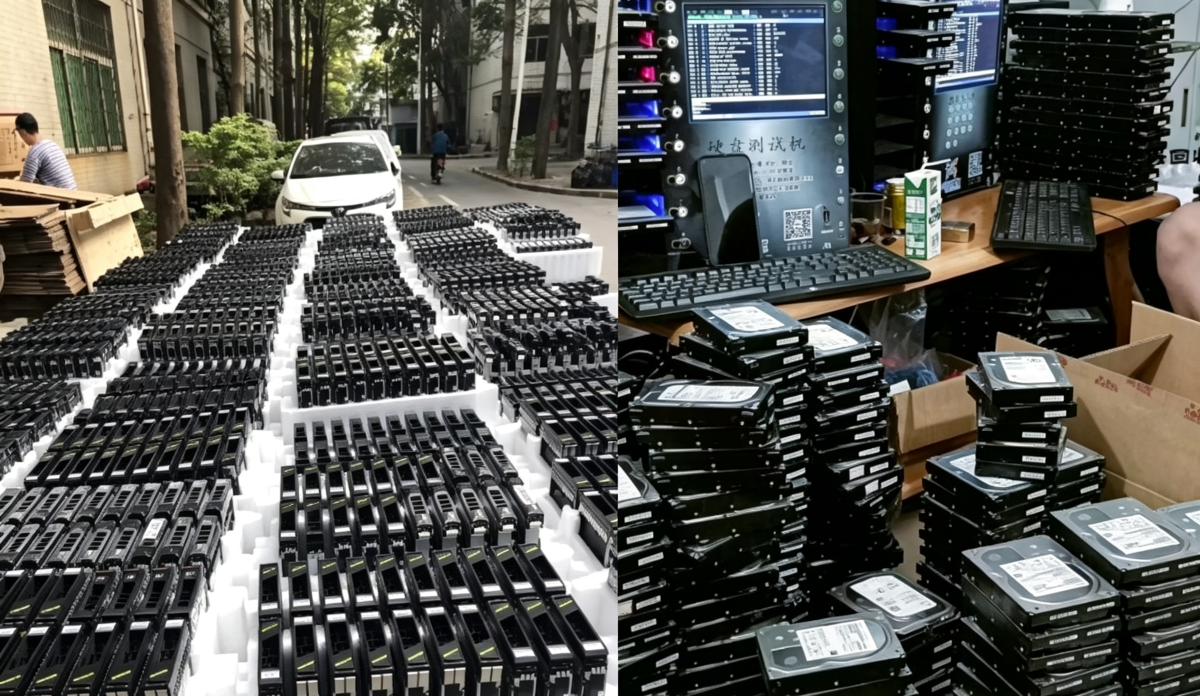
Which method is the safest and most effective for hard drive data destruction?
When discarding old hard drives, recycling computers, or scrapping equipment, the biggest pitfall is incomplete data deletion. Deleting, formatting, and quick partitioning only "hide" the data, which can be easily recovered with professional tools; choosing the wrong destruction method is like leaving a backdoor for privacy and confidential information.
Let's state the core conclusion first: Hard disk drives (HDDs) and solid-state drives (SSDs) cannot be treated the same way. In order of safety and compliance: Physical shredding > Demagnetization (HDD only) > Secure erasure (SSD only) > Compliant overwrite > Normal formatting/deletion. For top-secret/classified data, physical destruction is mandatory; for personal reuse, secure erasure/overwrite is preferred.
I. First, distinguish between HDDs and SSDs: their destruction logic is completely different.
• Hard disk drives (HDDs): Rely on magnetic platters to store data; vulnerable to strong magnets and physical damage; overwriting and demagnetization are both effective.
• Solid State Drives (SSDs): Rely on flash memory chips and wear leveling to store data. Demagnetization is ineffective, and ordinary overwriting is incomplete; Secure Erase/NVMe Format or direct chip shredding is necessary.
In short, avoid these pitfalls: Don't demagnetize SSDs, don't just perform ordinary overwriting; don't just format HDDs.
II. Five Destruction Methods, Security and Applicability Explained
1. Physical Shredding (Highest Security Level: Top Secret/Confidential/Financial/Government/Enterprise)
• Principle: Using professional equipment to crush the hard drive into fragments ≤2mm–5mm, completely destroying the platters/chips and physically preventing recovery.
• Applicability: Fully compatible with HDDs/SSDs; confidential, customer data, core secrets.
• Compliance: Complies with BMB-21, NIST SP800-88, ISO/IEC 21964; destruction report available, full video recording.
• Advantages: 100% unrecoverable, compliance guarantee; Disadvantages: Hard drive rendered unusable, requires professional organization/equipment.
2. Demagnetization and Destruction (HDD Only: Mass Retirement of Mechanical Drives)
• Principle: A strong magnetic field (≥5000 Oersted/1.5 Tesla) disrupts the magnetic domains, resulting in permanent data loss.
• Applicable to: HDDs only; completely ineffective for SSDs.
• Advantages: Fast batch processing, controllable cost; Disadvantages: SSDs are rendered useless, hard drives are rendered unusable.
3. Secure Erase (SSD Preferred: Reusable + High Security)
• Principle: Triggers firmware ATA Secure Erase/NVMe Format, clearing the FTL mapping table and OP reserved space, erasing the entire drive.
• Applicable to: Optimal for SSDs; also usable for new HDDs.
• Tools: PartedMagic, HDAT2, vendor toolkits (Samsung/Western Digital/Seagate).
• Advantages: Fast speed, reusable hard drives, cleaner than overwrite; Disadvantages: May not support older drives.
4. Compliant Overwrite (HDD Preferred: Reusable + Moderately Sensitive)
• Principle: Overwrites 0/1/random numbers multiple times according to standards to remove magnetic residue.
• Standards:
◦ Personal/Internal: DoD 5220.22-M (3 times)
◦ Confidential/Secret: BMB-21 (6 times), Top Secret (15 times recommended)
• Tools: DBAN, Eraser, vendor erasing tools.
• Advantages: Reliable and reusable for HDDs; Disadvantages: Not recommended for SSDs (wear leveling leads to incomplete erasure), time-consuming for large capacities.
5. Operations That Should Never Be Considered "Destruction"
• Deleting files, emptying the recycle bin
• Quick format, regular format
• Partition deletion, reinstalling the system
• Simple overwrite on SSDs, casually dropping HDDs
These can all be recovered, essentially no action taken.
III. Choose Directly by Scenario: No Need to Hesitate
Personal Users
• General Privacy, Continued Hard Drive Use: Secure Erasure for SSDs; DoD 3-times Overwrite for HDDs
• Disposal for Failure, Concerned About Leakage: Disassemble and damage the platters/chips; or hire a professional shredder.
Enterprise/Commercial Use
• Internal Reuse, Non-Sensitive: Secure Erasure (SSD) + Compliant Overwrite (HDD)
• Outsourced Repair/Recycling: Erasure first, then physical destruction is more secure.
• Confidential/Financial/Medical: Physical Shredding + Full Recording + Destruction Report
Confidential/High Compliance Requirements
• Mandatory: Registration and Approval → Technical Removal → Physical Destruction → Monitored Destruction with Record
• Standards: Shredding particle size ≤2mm–5mm; Overwrite ≥6–15 times according to security level; Demagnetization intensity meets standards.
IV. Final Security Priority (From High to Low)
1. Physical Shredding (Top choice for all media, top-secret and compliant)
2. Demagnetization (HDD only, efficient for batch processing)
3. Secure Erasure (Required for SSDs, reusable)
4. Compliant Overwrite (Reliable for HDDs, not recommended for SSDs)
5. Normal Formatting/Delete (Ineffective, strictly prohibited as destruction)
V. Three Last Life-Saving Reminders
1. Identify the drive before proceeding: Don't use SSD methods on HDDs, and don't trust demagnetization/normal overwrite on SSDs.
2. Choose erasure/overwrite for reusable media; choose shredding for non-reusable media.
3. Follow proper procedures for confidential information: Individuals shouldn't destroy media indiscriminately, and companies shouldn't just throw things away carelessly.
Truly secure destruction isn't just "appearing deleted," but rather technically unrecoverable and compliantly traceable. Choosing the method based on the media and determining the sensitivity level based on the type of information is the safest approach.
Mainland China Phone: 13049844111
Email: 13049844111@163.com
Hong Kong Phone: 852-52664790. Liang Kee Recycling Limited looks forward to your call to jointly usher in a new chapter of environmental protection and value!
Liang Kee Recycling has passed international standard certifications such as Quality Management (ISO 9001), Environmental Management (ISO 14001), and Information Security Management (ISO 27001). Safe, legitimate, and professional – we look forward to your call to jointly usher in a new chapter of environmental protection and value!