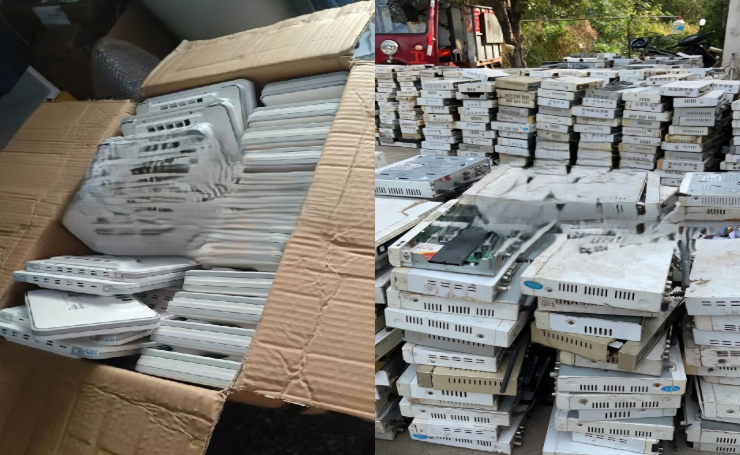
Waste optical modems and IPTV set-top boxes are being returned to Hong Kong for environmental recycling. Will a WEEE import/export license be required under the 2025 regulations?
I. Background of Regulatory Implementation
According to the "Waste Disposal (Amendment) Ordinance 2024" of Hong Kong, in line with the amendment to the Basel Convention on electronic waste, the new import and export regulations for electrical and electronic waste (EEW) will be fully implemented on January 1, 2025.
The new regulations have abolished some previous exemptions for small electronic waste, and have included all discarded electrical and electronic equipment in the Hong Kong Environmental Protection Department's WEEE import and export license supervision list. This list clearly includes discarded set-top boxes, optical modems, routers and other network terminal devices. This article is solely for the interpretation of regulations and policies and contains no commercial promotion content.
II. Core Determination Criteria: Differentiate between "worn-out and discarded equipment" and "second-hand reusable equipment"
Whether a certificate is required mainly depends on the nature of the goods and the destination of transportation. It is not based on the condition of the equipment's appearance or the quantity of the items.
(1) Scraping of optical modems and IPTV set-top boxes (for return to Hong Kong for recycling/destruction, with necessary certificates required)
If any of the following conditions are met, it will be classified as electrical and electronic waste (EEW) by the Hong Kong Environmental Protection Department. The 2025 regulations mandate that an EEEW import/export license must be applied for in advance:
The optical modems, IPTV set-top boxes that have been dismantled and scrapped by the operators, those that have malfunctioned and cannot be repaired, those that are outdated and obsolete, and those that have been returned upon lease expiration.
2. Goods in bonded storage that are stagnant, orders have been cancelled, and the products are restricted for domestic sales; the complete machines are transported to Hong Kong for dismantling, crushing, and environmentally friendly and harmless disposal.
3. The dismantled items only include the mainboard, circuit board, and built-in storage module of the optical modem and set-top box, without the complete casing of the complete unit; these are the waste materials.
4. The destination for the shipment of goods is an environmental protection recycling plant or destruction/disposal site in Hong Kong. There is no intention for the goods to be sold abroad for secondary use or for repair and reuse.
The official control list of the Hong Kong Environmental Protection Department clearly stipulates that old TV set-top boxes and discarded network terminal devices fall under the category of new mandatory licensing items to be implemented in 2025. There are no thresholds for weight, value, or sample exemptions. Small quantities of scattered waste equipment and large quantities of goods in entire containers are subject to the same regulatory requirements.
(2) Good second-hand reusable optical modems and set-top boxes (for export only, no need for certification)
If all the following conditions are met simultaneously, it can be regarded as a second-hand product rather than electronic waste, and there is no need for a WEEE import/export license when entering or leaving Hong Kong:
The power-on function of the equipment is in good condition. There are no missing core components or any malfunction or damage. It can be directly put into its original use.
2. The transportation destination is for secondary sales in overseas markets, professional repair and refurbishment, and it does not enter the local dismantling and recycling process in Hong Kong.
3. We can provide a complete equipment functionality test report and proof of export distribution channels, which will be available for verification by the Environmental Protection Agency and the customs.
III. Special Instructions for Transit, Mixed Loading, and Ancillary Components
Only transit through Hong Kong, without any local storage or disposal.
The scrapped optical modems and set-top boxes are transported through Hong Kong as a transit point. Whether they make a brief stop at the port or not, they fall under the category of cross-border transfer of electronic waste. According to the regulations of the Basel Convention, a WEEE transit import/export license still needs to be applied for, and there is no transit exemption policy.
2. The entire machine is equipped with a power adapter, remote control and power cord.
The power supply and remote control of the scrapped complete machine will be returned to the port for recycling. The entire device will be classified as electrical and electronic waste and will be uniformly included in the scope of license application. It cannot be separated and declared for exemption separately.
3. Transport the well-packaged second-hand equipment and scrapped materials in the same batch.
The two types of goods have different attributes and their control requirements are also different. They must be packed separately and declared separately for customs clearance. The scrapped parts need to apply for the WEEE license separately, while the intact second-hand equipment should be declared for the export of ordinary electronic products separately.
IV. Legal Consequences of Unlicensed Import and Export Activities
According to Chapter 354 of the Hong Kong "Waste Disposal Ordinance", the act of importing or exporting scrapped optical modems, set-top boxes, and other regulated electronic waste without obtaining a valid WEEE import/export license is a criminal offense:
First violation conviction: Maximum fine of 200,000 Hong Kong dollars and 6 months in prison;
2. Repeated violations and large-scale false reporting: The maximum fine is 500,000 Hong Kong dollars, and a prison term of two years will be imposed.
3. The customs has the authority to seize all the involved goods in full quantity until the enterprise submits all the complete compliance license documents, or orders the entire batch of goods to be returned to the mainland.
V. Core Required Materials for License Application
When enterprises submit applications for WEEE import and export licenses to the Hong Kong Environmental Protection Department, they must provide the following documents in full:
Domestic enterprise business license, and filing documents for import and export qualifications;
2. Description of scrapped equipment, listing the reasons for elimination, obsolescence, and failure-related scrapping, along with attached actual photos of the equipment;
3. The local environmental protection department of Hong Kong's licensed recycling and disposal institutions and the qualification licenses for site disposal are all in place.
4. Cross-border transfer declaration documents of the Basel Convention, description of the composition of the goods (indicating the presence of harmful substances such as circuit boards and built-in lithium batteries);
5. Comprehensive logistics transportation plan, compliance certificate for hazardous materials packaging and transportation (applicable for devices with built-in batteries).
VI. Clarification of Industry Frequently Asked Questions
Question: For brand-new, unused, and merely overstocked outdated optical cable set-top boxes, do we still need to obtain a certificate even if they are to be destroyed in Hong Kong?
Answer: Yes. The final destination of the goods is for dismantling and recycling. They lose their function as commodities and are uniformly classified as electrical and electronic waste by regulations. They are subject to the 2025 WEEE new regulations.
Question: The equipment is in good condition and just has a longer service life. Can it be treated as a second-hand device and thus not require a certificate?
Answer: No. The key factor for determination is the disposal purpose. As long as the items are transported to Hong Kong for destruction and dismantling, regardless of their appearance condition, they all fall under the category of waste electronic waste and a license must be obtained.
3. Question: Is it true that only the motherboards disassembled from the returned set-top boxes alone are subject to the same certification requirements?
Answer: Applicable. Waste printed circuit boards and terminal boards are included in the EEW control list and there are no exemptions.
Hong Kong Tel: 852-52664790. Liangji Recycling and Reuse Co., Ltd. has obtained international certifications such as Quality Management (ISO 9001), Environmental Management (ISO 14001), and Information Security Management (ISO 27001). It is safe, formal, and professional. We offer a complete service including recycling, reusing, and destruction of waste in Hong Kong. - Looking forward to your call and jointly starting a new chapter where environmental protection and value coexist!